


Virgílio Almeida, a professor in the Computer Science Department at the Federal University of Minas Gerais, Brazil, elected to TWAS in 2010, has received the inaugural edition of the UNESCO–Uzbekistan Beruniy Prize for Scientific Research on the Ethics of Artificial Intelligence (AI).
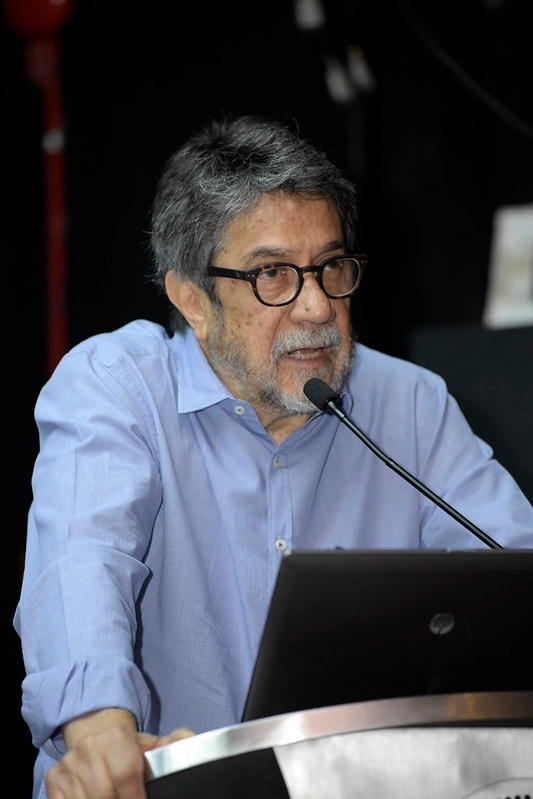
(Photo: Mario Marques)
The award ceremony took place on 6 November within the framework of the 43rd session of the UNESCO General Conference (30 October–13 November), in Samarkand, Uzbekistan. Almeida was one of three award recipients. The other awardees were Susan Perry, a human rights specialist, and Claudia Roda, a computer scientist, celebrated for their innovative research on youth-centred and AI ethics concerning privacy, education, and digital inclusion.
Established in 2024, the award is offered by UNESCO in partnership with the government of Uzbekistan, and honours initiatives and research that tackle the ethical challenges of AI and promote innovative solutions in this field. It is named after pioneering scholar Abu Rayhon Al-Beruniy, whose work in mathematics, astronomy, philosophy, and scientific inquiry paved the way for cross-disciplinary knowledge and intercultural dialogue.
With a PhD in computer science earned at Vanderbilt University, and a Master of Science in computer science from the Pontifical Catholic University of Rio de Janeiro, Almeida served as visiting professor at Boston University, Technical University of Catalonia, Polytechnic Institute of NYU. His career also includes research positions at the Santa Fe Institute, Hewlett-Packard Research Laboratory, and Xerox Research Center.
His research interests span large-scale distributed systems, social computing, autonomic computing, and performance modelling and analysis. He also focuses on examining the impacts of artificial intelligence on human behaviour, inequality, and public life.
“This prize carries profound symbolic meaning for our time—an era marked by turbulence, yet also by hope and the enduring power of the humanities to guide us in the age of AI,” said Almeida. “AI benefits are immense but so are the risks: the ethical and social challenges of AI rise not from the technology alone but how we use it. The central question is not what AI can do, but what it should do.”
With more than 120 papers and five co-authored books on performance modelling to his credit, Almeida advocates for ethical approaches to digital technology, emphasizing that it must serve the public good. In collaboration with Ricardo Fabrino Mendonça and Fernando Filgueiras, Almeida recently published the book Algorithmic Institutionalism: The Changing Rules of Social and Political Life (Oxford University Press).
Among his career-awards are the National Award in Informatics (1991) and the Great Cross of the National Order of Scientific Merit (2009). He is a member of the Brazilian Academy of Sciences. He has been a programme committee member of more than 20 conferences and member of computer science journal editorial boards.
The candidacy of Professor Virgílio Almeida to represent Brazil in the award was recommended by the National Commission of Brazil for UNESCO.
Cristina Serra