


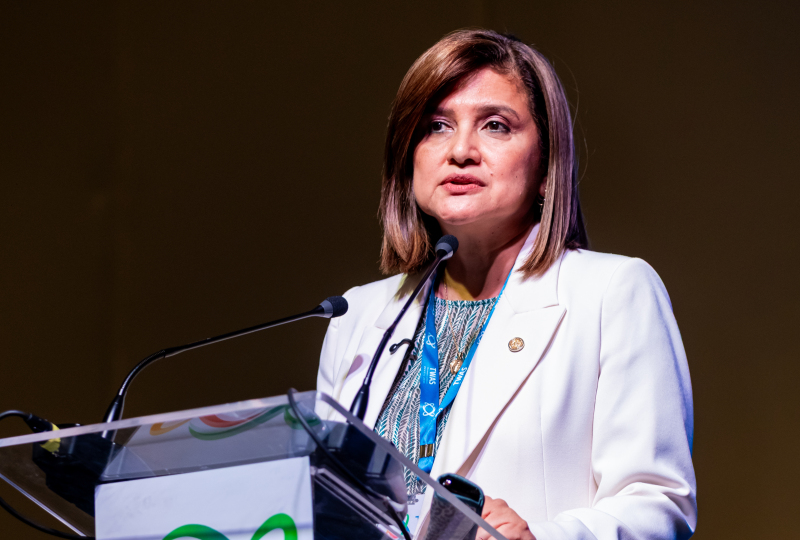
Many developing countries have benefited from prioritizing their dedication to scientific advancement, and at the 17th TWAS General Conference many of these benefits were visible. But Guatemala’s quest for scientific growth was particularly on display thanks to a keynote address from the nation’s Vice President Karin Herrera.
The Conference took place in Rio de Janeiro, Brazil, from 29 September to 2 October 2025. High-ranking national leaders have often taken part in TWAS General Conferences. This has included the heads of state of China, India, Rwanda, Senegal, Austria, and the Islamic Republic of Iran.
Herrera is a standout example of someone who fuses science and policy because, before her leadership role in the government of Guatemala, she had a successful career as a scientist, with degrees in biological chemistry, environmental studies, and sociology. Before her current role, she was the director of the Institute of Chemical and Biological Research at the University of San Carlos, Guatemala, and taught courses on microbiology there.
Herrera called it a great honour to reaffirm Guatemala’s commitment to TWAS, as well as shared values such as scientific excellence, capacity building, and especially science in service of decision making.
“We are confident that science must play a central role in shaping public policies that advance the well-being of all,” she said. “Science, innovation, and technology are the pillars of development for our countries. It is not only about generating innovation for subsectors, but ensuring that benefits reach the entire population.”
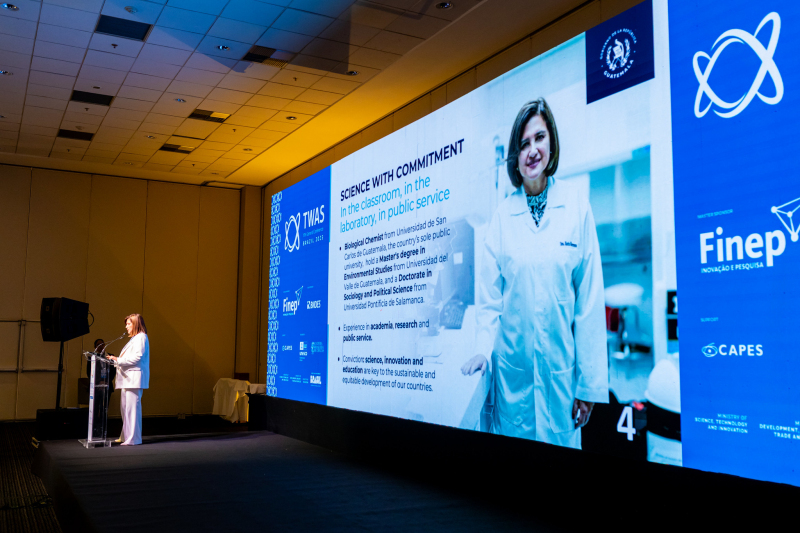
Herrera listed the accomplishments of science in Guatemala, including standing out in research in tropic diseases, participation in science competitions, and initiatives to elevate the voices of women in science, and provide them with the means to find training and careers in science, as well as conduct research on the condition of women in Guatemala.
She discussed the importance of research sectors such as nutrition, health, and climate change, properly addressing when scientific infrastructure suffers from obsolete equipment and hinders research, and coordinating with universities, research centres, and the private sector. She also touted Guatemala’s international connections.
“Through our cooperation with UNESCO we are promoting an ethical use of artificial intelligence, ensuring that advanced technologies are applied with inclusivity and with focus,” Herrera said.
“Our country is full of energy, and ideas to transform the country through science and innovation,” she added. “Our natural and cultural heritage provide open opportunities in biotechnology, agrobusiness, bioeconomy, and sustainable tourism. And international institutions such as TWAS and UNESCO provide scholarships and advanced training.”
She added that Guatemala has also made including children in science communities, through the project "Clubes de Ciencias", a priority to encourage citizen science and foster a long-term democratic spirit in support of science. She closed out by saying that countries must find opportunities, resources, and support ethical transformations that enable a sustainable future.
“Science must be a tool for the social transformation and national development and global development,” Herrera said.
She added: “Today, more than ever, we need to have efforts among governments, academia, the private sector, civic society, and international corporations so that science innovation and technology become drivers of progress and transformation of our progress.”
Sean Treacy