


Ana María Cetto Kramis, the former deputy director-general for technical cooperation at the International Atomic Energy Agency (2003–2010) and a TWAS Fellow since 1999, has been appointed chair of the UN Independent Scientific Panel on the Effects of Nuclear War.
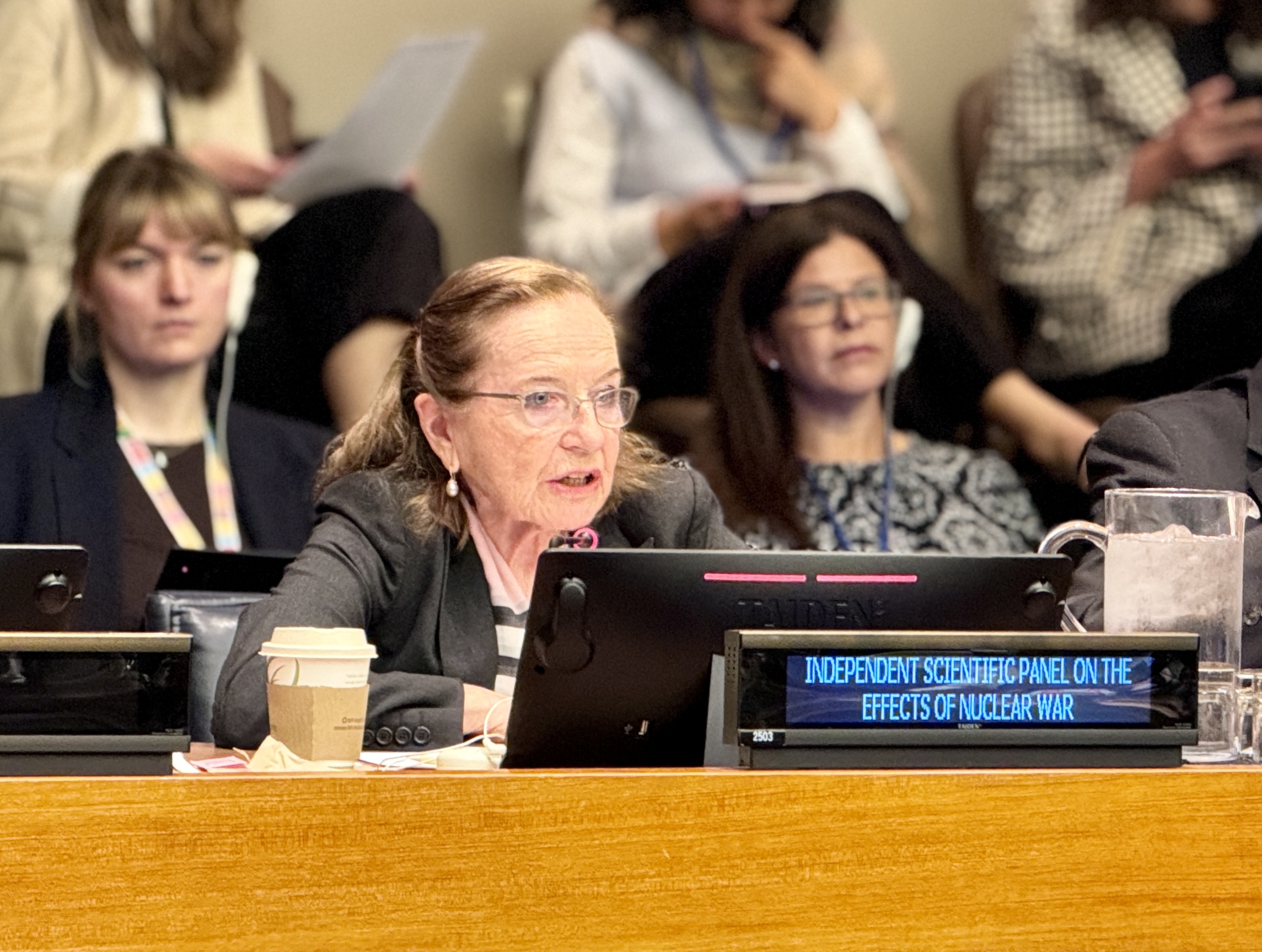
On 18 July, UN Secretary-General António Guterres announced the appointment of such a panel to assess the consequences of nuclear war, from its immediate effects to long-term global impacts. The 21 appointed members were selected from diverse scientific disciplines, including nuclear and radiation studies; climate and atmospheric sciences; environmental research; agriculture, biology, and the life sciences; public health and medicine; and the behavioural and social sciences with applied economics.
“I am fortunate to chair a panel whose distinguished members bring a wealth of expertise in various fields,” she said during the briefing to the First Committee of the General Assembly, on 21 October. And she added: “I am encouraged by the progress that has been made so far, as well as by the commitment and cooperative spirit of the panel members.”
Cetto holds a master’s degree in biophysics from Harvard University (USA), and a master’s and PhD degrees in physics from the National Autonomous University of Mexico (UNAM). She is now a full research professor in the physics institute, and the founder and current holder of the UNESCO chair on science diplomacy and heritage, both at UNAM.
Upon her nomination to chair of the nuclear war effects panel, Cetto resigned from the International Decade of Sciences for Sustainable Development advisory committee, where she served as a member from October 2024 to September 2025.
She also served as director of the Faculty of Sciences, the Museum of Light and the Mexican Journal of Physics, OWSD vice-president, consultant to UNESCO for the World Conference on Science.
She is the co-recipient of the 1995 Nobel Peace Prize as a member of the Executive Committee of the Pugwash Conferences, and of the 2005 Nobel Peace Prize as IAEA's Deputy Director General.
Among her accolades are: the AIP Tate Medal for International Leadership in Physics (2025), the Oganesson Prize (2024), and the UNESCO-Kalinga Prize (2023).
Cristina Serra