


Rwandan physicist Romain Murenzi, a former executive director of TWAS, has been elected a Fellow of the American Physical Society (APS).
Murenzi served two terms as executive director of TWAS, one from 2011–2016 and the second from 2017–2023. APS recognized him for “his extraordinary leadership in leveraging science for peace and progress: creating opportunities for women and girls in science, championing STEM education in Rwanda and the developing world, and launching innovative programs fostering sustainable global collaborations and excellence.”
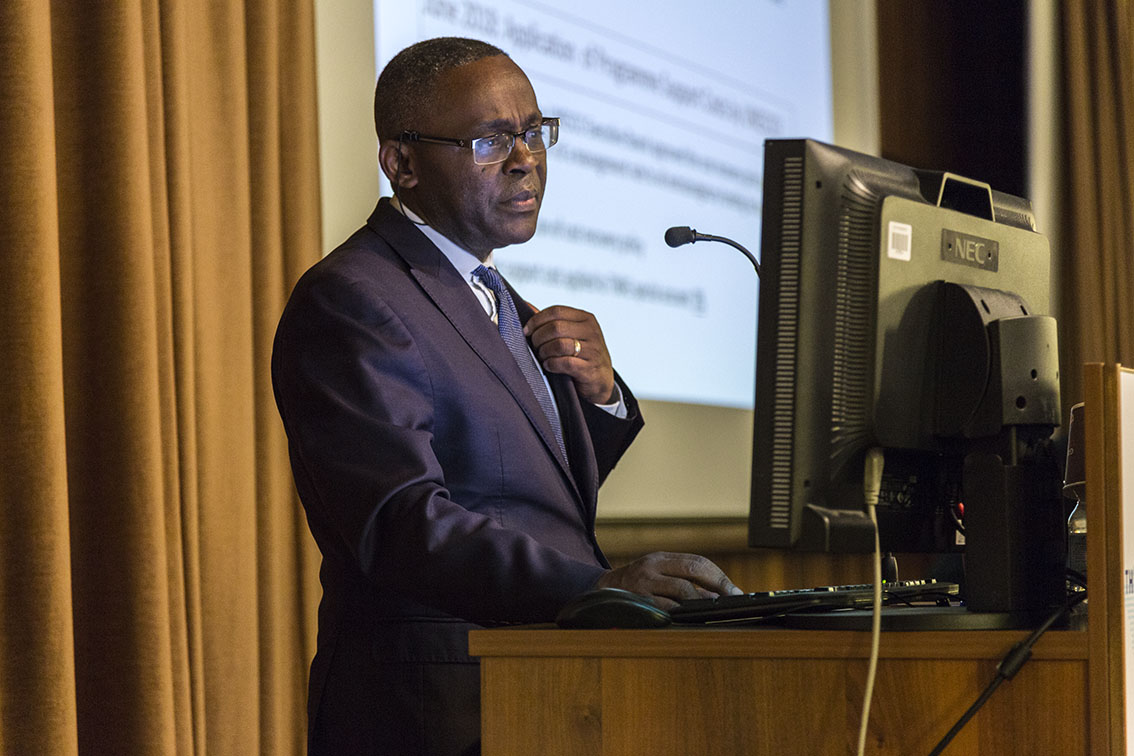
"I am grateful to the American Physical Society for this recognition,” said Romain Murenzi.
“Science is instrumental to building peace and prosperity, and I am optimistic that we can build a world in which the benefits of scientific discovery and innovation are accessible to all, regardless of nationality or gender. Through science diplomacy, science can serve as an honest broker among nations, fostering dialogue and cooperation, while also providing powerful tools for poverty alleviation, economic growth, and shared prosperity,” he said.
Now a professor at Worcester Polytechnic Institute (Massachusetts, USA), where he joined in 2024, Murenzi has built a distinguished career not only as a passionate physicist and mathematician, but also through his commitment to education and to transforming lives for the benefit of society.
In the aftermath of the 1994 Rwandan genocide that ravaged the country, he served as Rwanda's Minister of Education, Science, Technology and Scientific Research (2001–2006), and as Minister in the President's Office in Charge of Science, Technology, and Scientific Research (from March 2006 to July 2009), with responsibilities including information and communications technology.
Building on these leadership roles, he gained extensive expertise in international science policy, science diplomacy and education. In 2009, after leaving Rwanda he joined the American Association for the Advancement of Science (AAAS), in Washington D.C., as a senior scholar, and then was appointed the director of the AAAS Center for Science, Technology and Sustainable Development.
Murenzi's association with TWAS began with his election as a Fellow, in 2005, marking the beginning of a long and fruitful association with the Academy. He also served on the TWAS Council as vice-president for Africa, from 2007 until 2010, before being appointed TWAS executive director in 2011.
During his first term at TWAS, the Academy witnessed substantial growth in its education and training activities, consolidated its position in global science policy, launched a science diplomacy initiative, and increased its global audience through a new digital communications platform.
Between 2014 and 2015, Murenzi chaired the UN Secretary-General’s High-Level Panel on a Technology Bank for Least Developed Countries, helping to shape its scope and functions.
A short 14-month period at UNESCO headquarters in Paris, from 2016 to 2017, saw him direct the Division of Science Policy and Capacity Building in the Natural Sciences sector. In September 2017, he returned to TWAS for a second term as its executive director, succeeding Sudanese mathematician Mohamed Hassan, who had served as the Academy’s founding executive director from 1985 until 2011, and again in an interim capacity after Murenzi’s departure to Paris.
In advocating what he calls innovation ecosystems, Murenzi has consistently reaffirmed the need to support education at every level, the inclusion of women in science, effective science policy, the establishment of science and engineering academies, the development of technology and robust international cooperation.
Cristina Serra