

The current Ebola outbreak has exposed a familiar reality: We need strong science and delivery systems to rapidly identify, understand, detect, treat and prevent the spread of emerging and re-emerging threats in order to mitigate their social and economic impacts. The lesson is not new, but it remains urgent particularly in the global South that continues to bear a disproportionate burden of infectious disease threats.
The response to an outbreak begins long before a disease makes the news. It depends on astute clinicians and community members; diagnostic laboratories with available point of care rapid diagnostics; well-trained researchers, strong research and healthcare-delivery institutions, the ability to convert evidence into actionable knowledge that can be used to inform policy decisions, and effective communication with the public. These resources and skills cannot be assembled during a crisis. It is key that ongoing investments are made and funding sources for training and capacity building is nurtured during the periods while threats are dormant.
This perspective of pandemic preparedness informed the TWAS's 2026 Skills Building Workshop in Ghana, which brought together 26 early-career scientists from 13 countries and supported through the Seed Grant for New African Principal Investigators (SG-NAPI) Programme, supported by the Federal Ministry of Research, Technology and Space of Germany (BMFTR).
Over three days, scientists were exposed to interactive sessions on science writing, mentorship, science communication, transdisciplinary research, and the responsible use of artificial intelligence. These fields may seem distant from the front lines of an outbreak. They are not. The ability to rapidly generate evidence for informed decision-making is critically important; as is the ability to communicate it, apply it, and strengthen research and healthcare-delivery institutions.
TWAS recognizes that today's complex and wicked challenges do not fit neatly into disciplinary or national boundaries. Epidemics and pandemics; climate impacts, food security; surveillance systems; development and upscaling of diagnostics, therapeutics and vaccines; growing inequalities, natural disasters, wars and conflicts with resultant displaced populations are increasingly intertwined. Supporting scientific excellence and innovation to enhance resilience means investing in researchers, networks and institutions that enable impactful evidence generation.
When the next crisis comes, countries across the global South will need the scientific capacity to lead the response and they will also need strategic and synergistic global partnerships and resource mobilization to ensure outbreaks do not become epidemics and epidemics do not become pandemics. This remains one of the most important investments we can make that benefits low- and middle-income countries and industrialized nations.
How can we ensure that scientific evidence and expertise can be shared across geo-spatial and political borders and reach the communities and institutions where decisions need to be made? Here, science diplomacy is indispensable. The 13th AAAS–TWAS Course on Science Diplomacy equipped participants with the skills they need to embrace this fast-evolving field. The programme reflected a growing recognition that many of the challenges facing the world today require cooperation and effective partnerships as much as they require scientific expertise for the technological innovations.
As Lamberto Moruzzi, Director for Scientific, Space and Sports Diplomacy at Italy's Ministry of Foreign Affairs and International Cooperation, eloquently told participants, "Science is a shared driver of progress and not a geopolitical currency." The principle is worth remembering.
Building scientific capacity is essential, but so is creating the trust, partnerships, and channels of dialogue that allow knowledge to inform collective action. Science diplomacy remains one of our strongest tools for addressing complex challenges with evidence, transparency, and shared responsibility. Science remains forward looking and brings hope.
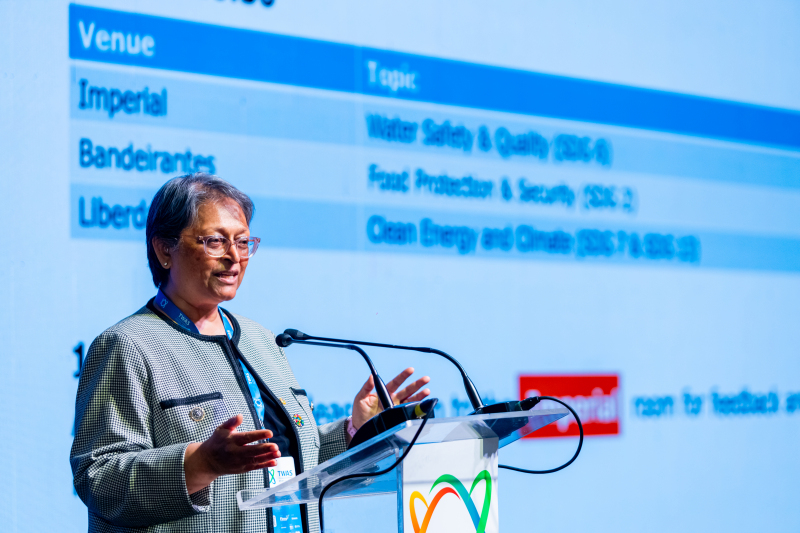
Quarraisha Abdool Karim, President of TWAS